
Spaghetti Junction from above: inside Britain’s most complex interchange
 Jack Moriarty Posted On July 24, 2026
Spaghetti Junction – officially Gravelly Hill Interchange, remains the most complex interchange on the British road network more than fifty years after it opened. More than fifty years after it opened, Gravelly Hill Interchange, better known as Spaghetti Junction, remains the most complex interchange on the British road network. From ground level it appears as a maze of concrete columns and overlapping carriageways. From the air, the engineering becomes far easier to understand. Five levels of road pass over three canals, two rivers and two railway lines, all within a compact 30 acre site on the northern edge of Birmingham.
We flew Spaghetti Junction to capture the scale and complexity of one of Britain’s most recognisable motorway interchanges. Watch the aerial footage below.
Why it exists
Spaghetti Junction is junction 6 of the M6, where the motorway connects with the A38(M) Aston Expressway. It formed the centrepiece of the Midland Links motorway project, designed to connect the M1, M5 and M6 while providing direct access into Birmingham.
Construction began in 1968 and took four years to complete, opening to traffic on 24 May 1972.
The nickname appeared before the interchange was even built. A Birmingham Evening Mail reporter compared the proposed layout to a plate of spaghetti after seeing the plans. The name quickly caught on and eventually entered the Oxford English Dictionary, despite never appearing on official road signs.

The scale of it
The aerial perspective reveals the sheer size of the structure.
- 559 concrete columns, with the tallest reaching around 80 feet
- Five levels of carriageway stacked above the valley floor
- Covers around 30 acres
- Serves 18 routes with approximately 2.5 miles of slip roads
- Built using around 13,000 tonnes of steel reinforcement and 170,000 cubic yards of concrete
Because the interchange crosses an existing network of canals and rivers, engineers had to carefully position each support column. Navigation on the canals had to remain possible, even allowing horse drawn narrowboats to pass underneath without their towropes catching on the structure above.
Second image: Aerial or ground photograph showing the stacked carriageways and supporting columns.
Alt text: Multiple levels of the Gravelly Hill Interchange showing overlapping motorway decks supported by hundreds of concrete columns.
A structure that never stops needing work
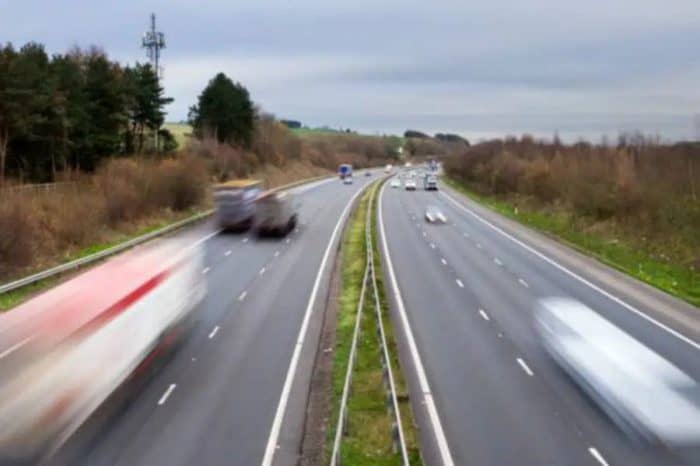
When Spaghetti Junction opened it carried around 40,000 vehicles each day. By 2002 that figure had risen to around 140,000. Today, more than 200,000 vehicles use the interchange daily, including significant volumes of freight travelling across the strategic road network.
That constant demand means the interchange is in a continuous programme of inspection, maintenance and strengthening. National Highways has invested in structural repairs, resurfacing, technology upgrades and managed motorway systems to help keep traffic moving while extending the life of one of Britain’s busiest pieces of infrastructure.
Seeing it from the air
Flying above Spaghetti Junction provides a perspective that simply isn’t possible from the ground. The overlapping carriageways, canals, railway lines and rivers become visible in a single frame, making it much easier to understand how every part of the interchange connects.
From an inspection and documentation point of view, aerial imagery also highlights the scale of the supporting structure, the condition of the decks and the relationship between the road network and the surrounding infrastructure. It is one of the few locations where a drone can capture the complete engineering story in a way traditional ground photography cannot.
Why Spaghetti Junction is still one of a kind
Britain has built larger and busier motorway junctions since 1972, but none has matched the complexity of Spaghetti Junction. It remains one of the country’s best known engineering landmarks and has appeared in popular culture, including the film Ready Player One.
Viewed from above, the nickname makes perfect sense. More importantly, it highlights the remarkable engineering that allows hundreds of thousands of journeys to pass through the junction every day.
Stay sharp
Never miss a story
The daily highways digest, straight to your mailbox.
You will get a confirmation email. Unsubscribe anytime. About The Highways Industry Newsletter →